Why a Basketball Court Has a Key
Understand the basketball key, its court markings and the rules they signal, so you can follow lane positioning and free throws with greater confidence.
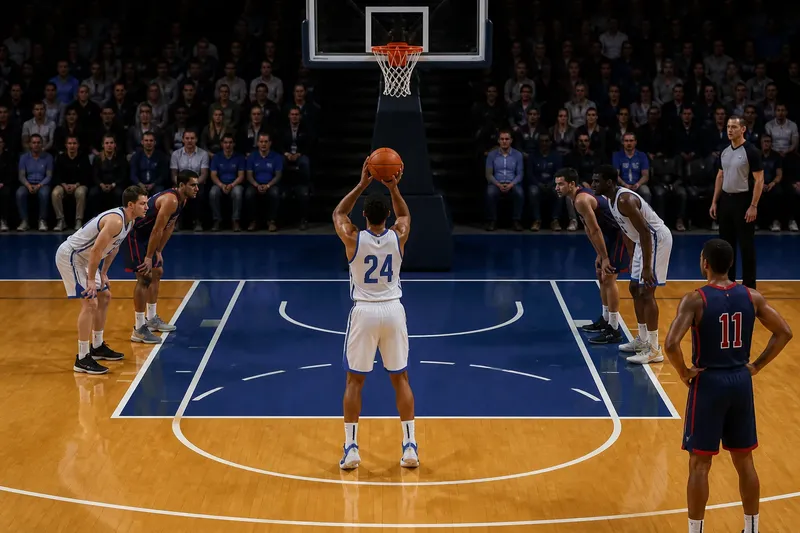
The basketball key helps you read the action beneath the basket: its boundaries mark the lane, while the rules attached to that space depend on the competition and the play. During a free throw, for instance, players may occupy only the spaces permitted by that competition’s rules.
The basketball key
The key, also called the lane or the paint, is the marked area extending from the baseline towards the free-throw line. Its name recalls an older lane shape that resembled a keyhole. Modern courts commonly use a rectangle, but exact dimensions and line details vary by competition.
The lane’s long sides, baseline and free-throw line make its outline. The free-throw semicircle sits at its outer end, and some courts also mark a restricted area near the basket. These lines identify zones; their presence alone does not tell you every rule that applies.
“The paint” remains a familiar nickname whether the lane is shaded or the same colour as the rest of the floor. The boundary markings, rather than the colour, define the area.
Why the lane matters
The lane gives players and officials a visible reference near the basket. Rules use that area to judge matters such as offensive positioning and the placement of players during free throws. The key is not a wall: players can enter, leave and cross it unless a specific rule restricts them.
Imagine a forward waiting in the opponents’ lane while a teammate controls the ball in the frontcourt. If the applicable offensive three-second rule is in effect and the forward remains there too long, an official may call a violation; if the forward leaves in time, play continues. The exact rule and its exceptions are set by the competition.
Three-second restrictions
Many forms of basketball restrict an offensive player from remaining in the opponents’ lane for more than three seconds while the player’s team controls the ball in the frontcourt. The restriction discourages an attacker from staying near the hoop without moving. Details, including how officials count and what exceptions apply, can differ.
This is not automatically the same restriction for defenders. Some competitions have a separate defensive three-second rule, while others do not. To interpret a call, identify the league or competition and use its rulebook rather than assuming one version applies everywhere.
For a viewer, watch the attacker’s position and the state of possession together. A player in the lane is not, by that fact alone, committing a violation.
Free-throw lane positions
Free-throw positioning is competition-specific. The applicable rules determine which players may occupy marked lane spaces, which players must stay elsewhere, and when each may move towards a rebound. Do not assume that every competition assigns identical spaces or uses identical restrictions.
The shooter takes position at the free-throw line and must observe the rules governing the shot, including the timing and line restrictions in that competition. Lane players may be restricted from entering the lane too early or leaving an assigned space before release. The consequences depend on who commits the violation and whether the shot succeeds.
Say you are watching a free throw and a player steps into the lane before the ball leaves the shooter’s hand. Note the player’s position and the moment of release, then check which competition is being played: that rule set determines whether the movement is a violation and what follows. Watching the feet and the ball together makes the sequence easier to follow.
Reading nearby markings
The lane lines identify the area used by rules such as offensive three seconds and free-throw positioning. The free-throw line marks the shooter’s position. The restricted-area arc beneath the basket has a different role: in competitions that use it, it can inform officials’ assessment of certain collisions near the hoop.
That arc is not a general no-contact zone and does not decide every collision by itself. Officials consider the applicable rule and the play around the contact. The three-point line serves another purpose entirely: it helps determine whether a successful field goal is worth two or three points, depending on the shooter’s position under the competition’s rules.
Why court markings differ
Lane dimensions, free-throw details and restricted-area markings can vary across rule sets. NBA, FIBA and college basketball courts may therefore look familiar without being identical. A line’s role and the interpretation of a call depend on the competition, not just on its appearance.
If a marking or ruling seems unfamiliar, identify the competition first. Its court specifications and rulebook are the appropriate references; a similar-looking line elsewhere may serve a different purpose or be governed differently.
Questions about the key?
Are the key and the paint the same area?
Usually, yes: “key”, “paint” and “lane” commonly refer to the marked area beneath the basket. The wording is informal, so context and local usage can vary.
Can a defender stay in the key?
A defender is not ordinarily subject to the offensive three-second restriction. Some competitions apply a separate defensive restriction, so consult the rules for the match you are watching.
Must a player shoot from the key?
No. The key marks an area of the court, not a required route or shooting spot. Players can shoot from elsewhere, subject to the usual rules governing the attempt.
Does touching a lane line count as being in the lane?
For rules based on lane position, a boundary line may be treated as part of the area it encloses. The relevant competition’s rule wording and the official’s judgement determine how a particular position is assessed.
Following the action
Start with the shape of the lane, then ask what is happening: open play, a free throw or contact near the basket. The situation determines which markings and restrictions matter. During a free throw, compare the players’ positions with the rules for that competition and watch for movement before release.
For the basketball key, the useful distinction is between a boundary and the rule applied to it. The paint shows where a player is; the game situation and governing rules explain whether that position is allowed. Check the competition before judging an unfamiliar lane call, especially when comparing domestic and international play.