The Round Robin: Everyone Meets the Field
A round-robin schedule lets every entrant face every other one, making results easier to compare and giving organisers a clear route from fixtures to standings.
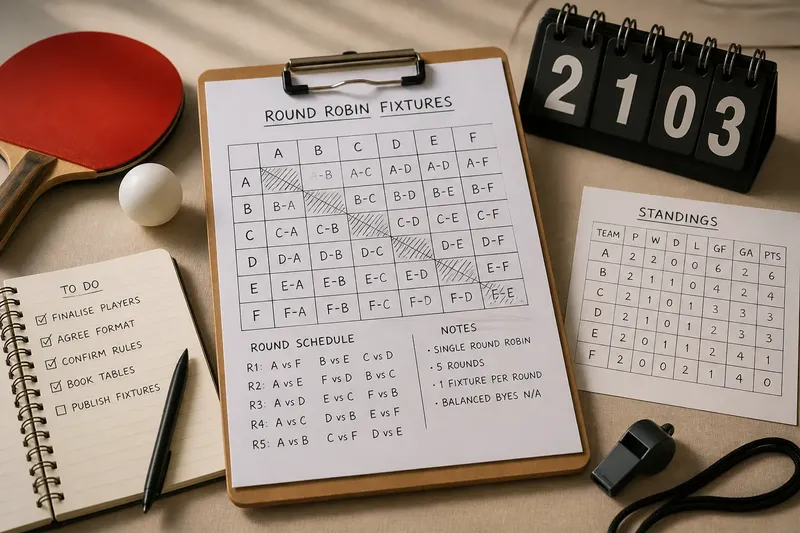
A round-robin schedule gives every entrant a match against every other entrant in the group. To build one, list the competitors, decide whether each pairing happens once or twice, then arrange the fixtures so every team or player can take part without clashes. That repeated contact is the format’s defining feature: it offers a fuller comparison than a bracket in which one defeat can end a campaign.
Choose the competition field
Start by defining exactly who belongs in the round robin. It might be a group within a larger tournament, a league division, or the whole field in a small competition. Write each entrant’s name on a separate line and settle any eligibility or seeding questions before making fixtures. A schedule cannot be complete until the field is settled.
Next, decide whether opponents meet once or twice. A single round robin gives each pairing one fixture. In a double round robin, every pairing is repeated, often with each side hosting once where the sport allows a home venue. The second version can soften the effect of venue imbalance, but it also adds fixtures and may require more time and resources.
Consider what the competition is meant to decide. If organisers need a reliable ranking among a compact group, a single round robin may be enough. If home advantage, travel or uneven conditions matter, a return meeting can give the standings more context. More matches do not automatically make a format fairer if the extra demands prevent some entrants from participating fully.
Write down the format decision before you move on: entrant list, meetings per pairing, and whether fixtures have designated home sides.
Build the fixture list
For a small field, you can draft the schedule by listing every unique pair of entrants. With four teams—A, B, C and D—the single-round-robin pairings are A–B, A–C, A–D, B–C, B–D and C–D. Each pairing appears once, so each team has three fixtures. A double round robin repeats those pairings, usually with the home designation reversed where applicable.
For a larger field, a rotation method keeps the work manageable. Place the entrants in a row, pair the first with the last, the second with the second-last, and continue towards the middle. Keep one entrant fixed, then rotate the others between rounds and make a fresh set of pairings. Check every round against the previous one: no pairing should recur in a single round robin, and no entrant should appear twice in the same round.
An odd number of entrants needs a bye in each round. Add a temporary placeholder, pair it like any other entrant, and mark the opponent as having a bye rather than a fixture. Rotate the placeholder too, so the pause moves among the field. If there are five teams, one team sits out in every round; the schedule should distribute those byes as evenly as possible.
Imagine a school club arranging a six-player table-tennis group. The organiser writes down all six names, lists each unique pairing, and then separates those matches into rounds so nobody is assigned to two tables at once. The visible result is a fixture sheet players can follow, with every pairing accounted for before play begins.
Set the playing order
A complete list of pairings is not yet a usable timetable. Assign rounds, courts or fields, start times, and any home designations. Leave enough space between fixtures for the venue to reset and for players to move between locations. In team competitions, check that players are not scheduled for overlapping matches in another division or event.
Then look at the sequence each entrant faces. A rotation can produce a mathematically complete schedule while giving one team a run of difficult travel days or leaving another with a long gap between appearances. Adjust the order where practical, but preserve the pairings and make the changes visible to everyone.
For a double round robin, avoid simply placing every return fixture immediately after its first meeting unless the competition has a reason to do so. Spacing the meetings gives both sides time to adapt and can make the second contest feel like a genuine rematch rather than an instant replay. Keep the schedule clear about which venue or side is designated home.
Publish one authoritative fixture list. If a match moves, update that copy and tell affected entrants directly; scattered versions invite missed fixtures and confusion.
Agree how standings work
Before the first match, state how results become table positions. A common approach awards points for wins and may award a different amount for draws, where draws are possible. The exact system depends on the sport and competition, so publish the rule rather than assuming everyone knows it. Explain what happens after a walkover, withdrawal or abandoned match as well.
Also set the tie-break order. Options used in different competitions include results between tied entrants, overall points or goals difference, total scored, or a further play-off. These methods can produce different rankings, so the order matters. If head-to-head results come first, specify how the rule applies when several entrants are level, not only when two are tied.
Keep the table legible. Show fixtures played, wins, draws if relevant, losses, the chosen scoring columns and points. Add tie-break figures only if the rules use them. A reader should be able to trace a position back to match results instead of treating the ranking as an unexplained verdict.
Check the competition regulations and governing body’s rules where they determine scoring, eligibility or tie-breaks; use those requirements in the published format.
Track results consistently
After each round, record the result against the correct pairing and update the table using the agreed rules. Keep a separate results record as well as the standings. If a score is disputed or corrected, the record makes it possible to update the table without guessing which fixture changed.
Before announcing a new order, check that every result belongs to a completed fixture and that postponed matches remain clearly marked as outstanding. Do not quietly treat an unplayed match as a win or a loss unless the competition rules specify that outcome. A transparent note is more useful than a table that looks complete but hides a decision.
When an entrant withdraws, pause before deleting its results. Some formats retain completed results; others remove or recalculate them, depending on the rules. Apply the published policy consistently and explain the effect on the table. A late change can alter the comparison for everyone, not just the withdrawing entrant.
What does the format change?
How does a round robin differ from elimination?
In an elimination bracket, a loss can end an entrant’s run, while a round robin schedules further matches against the rest of the field. The latter makes the final ranking depend on a set of results rather than one knockout fixture. A bracket is usually easier to shorten when time is tight; a round robin offers more direct comparisons but needs more playing opportunities.
How many matches does it create?
Every unique pairing must appear once in a single round robin, and twice in a double round robin. The fixture count therefore grows quickly as entrants are added, which is why organisers should check venue time and availability before confirming the field. For a large group, splitting entrants into pools can keep the schedule workable, though it means not everyone meets everyone.
What happens when entrants are uneven?
With an odd number of entrants, one has a bye in each round, so the schedule needs to spread those pauses fairly. With an even field, every entrant can usually play in each round, though venues and availability may still force different rest periods. Make byes and postponed matches easy to distinguish on the fixture sheet.
Can the leading entrant be settled early?
Sometimes the table makes the outcome clear before the final round, but the remaining fixtures still matter for lower places, qualification or tie-breaks. Avoid treating an early leader as champion unless the rules say the competition can end at that point. Finish the scheduled matches or state the formal procedure for ending play early.
Read the table carefully
A round robin rewards consistency across opponents, but it does not remove every scheduling advantage or uncertainty. Entrants may face different conditions, and a late fixture can matter more than an early one if the table is close. The format’s strength is that it makes those results visible across the field, giving players and spectators a sequence to follow rather than a single do-or-die path.
When you read a round-robin table, look beyond the top row: check games played, outstanding fixtures and the tie-break rule before deciding what a position means. When you organise one, make the pairing list, schedule and ranking rules available together. That small habit lets everyone see not only who is ahead, but how the competition will settle the places still in question.