Watching a Match Without Knowing Every Rule
Watching a match without knowing every rule gets easier when you follow one player, identify each side’s aim and spot the moments that reset the action.
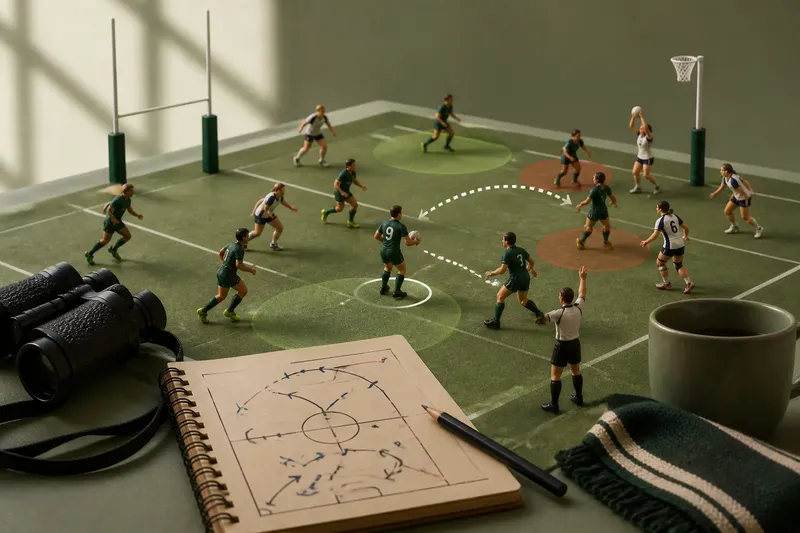
Watching a match without knowing every rule is easier when you give your attention a clear job: follow one player, identify each side’s aim and notice when play starts again. At a rugby, netball or volleyball match, you can follow the pressure and movement before you understand every whistle.
Use the ideas below in whichever order suits the sport. They are ways to read the action, not substitutes for learning rules that matter to you.
Choose One Player
Pick someone whose role is visible from your seat: a goalkeeper, scrum-half, setter or player carrying the ball. If you do not know the positions, follow the person who repeatedly appears near the centre of the action.
Watch what they do before touching the ball. Do they scan the space, point to a team-mate, hold their position or move towards an opponent? A run into open ground may offer a passing option; a player hanging back may be covering a possible counter-attack.
Stick with your choice for a short passage instead of switching whenever the ball moves. If you lose sight of the player, find the ball first, then look for them in the next phase. A shirt number or distinctive boots can help at a crowded venue.
Find The Basic Aim
Work out what each side is trying to achieve before puzzling over a disputed call. One team may carry or pass the ball towards a scoring area, put it beyond a line or send it into a target. The other tries to interrupt that progress.
Ask yourself: who has the ball, where can they make progress, and what is the opposition doing to stop them? You can follow possession, space and pressure without knowing the precise value of a score or every boundary rule.
Imagine you are watching an unfamiliar court sport. One side moves the ball towards a marked area while the other closes passing lanes and steers the carrier away from the centre. Even without knowing how points are scored, you can see the immediate contest: create a route forward or take it away.
Notice how the shape changes with possession. The team with the ball may spread out to offer options; the defending team may gather around the most dangerous route.
Notice The Reset
A reset is a pause or restart under a new condition. It might follow a score, a ball going out, a foul, a dropped ball or a whistle. Look for the visible change: players stop, move to new positions or wait for the next action.
Rather than reconstructing every detail of a call, watch what happens next. Does one team gain the ball? Does play restart from a marked spot? Do players line up, spread out or take set positions? Those clues show whether possession, location or the shape of the next phase has changed.
A whistle can stop play for an infringement, mark the end of a period or accompany a score. Check the referee’s signal and the players’ response; together, they often clarify what happens next.
If the ruling remains unclear, keep the question small: who acts next, and from where?
Read The Space
Look beyond the ball to see where players leave room and where they crowd together. An open channel may invite an advance; a packed area may show that defenders are containing a threat or trying to win the ball back.
Follow the ball, then glance at the players ahead of it. Are they moving towards open ground, offering short passing options or drawing defenders away? This can explain a pass that does not travel directly towards the scoring area.
Use lines, circles, end zones and marked areas as reference points. You do not need to memorise every boundary. Notice which spaces players keep trying to enter and which they avoid.
If you can choose a seat, a higher or more central view may make team shape easier to see; a lower view may make speed and physical contests more immediate.
Listen For Useful Clues
A sudden crowd reaction can point you towards a scoring chance, mistake or close decision. A whistle marks an interruption, while a coach or team-mate calling out may draw attention to a run or an approaching opponent.
Do not assume the loudest reaction explains the rule. Supporters may respond to a near miss or see a call from a different angle. Use the noise as a prompt to find the ball, the official and the player involved.
If you are with someone who knows the sport, ask one focused question during a pause: “What changes after that whistle?” or “Why did they move back there?” A specific question is easier to answer than a request for every rule at once.
A scoreboard or public announcement can confirm the score and period. Use that information to orient yourself, then return your attention to the action.
Useful Questions?
What should I watch first?
Start with a player who is consistently involved, then follow the ball when they leave the play. This gives you a clear thread without requiring you to track everyone.
How can I tell who is attacking?
Look for the side moving the ball towards its scoring area and the side trying to block that progress. If the direction is unclear, check who has possession and where the opposing players are gathering.
What does a whistle mean?
It means play has stopped, but the reason and consequence depend on the sport and situation. Check the referee’s signal and where the ball goes next.
Do I need to learn the rules before I go?
No. Knowing the basic aim can help, but you can build understanding as you watch. Ask about a rule during a pause or consult the sport’s official explanation afterwards if you want more detail.
Let The Pattern Build
Once you can see the aim and the resets, look for choices that recur. Does a team keep using the same side? Does one player draw defenders before passing? Does the other side respond by closing the middle? You can notice a pattern without knowing its tactical name.
Keep your observations tentative. A team may change its approach after a score, an injury stoppage or a substitution. Watch for a choice to recur before treating it as a settled plan.
Say you are following a match and notice a player moving wide just before a team-mate advances through the centre. On the next possession, watch whether that same movement draws a defender away again. If it does, you can see how the players are using space; if it does not, look for another explanation, such as a change in possession or a different defensive position.
For your next unfamiliar game, take one question with you: what is the player you are following trying to make possible? Watching a match without knowing every rule becomes easier when you can see the intention behind a movement. If an official decision still puzzles you, note the moment and ask about it during a pause.